
Streamline Your Payment Processing
Effortlessly manage in-person and online transactions with our comprehensive payment solutions.
Payment Gateway Services UK: Take Payments Without Overpaying
Want to accept payments online without losing a chunk of your revenue to inflated fees? We can help. As a specialist merchant services broker, we work across the UK payments landscape to find you the right payment gateway, the right acquiring bank, and the right deal. This guide explains how payment gateways work, what they cost, and how we use our buying power to cut those costs for you.
Key Takeaways
-
A payment gateway is the secure bridge that lets a UK business accept card and electronic payments online, in app, and remotely. It securely transmits payment information between all parties involved in a transaction.
-
We act as a merchant services broker in the UK, using our cumulative volume with acquiring banks and payment gateway providers UK wide to negotiate lower processing and gateway rates for our clients.
-
We help set up both a payment gateway and a merchant account so the full payment flow works smoothly, from customer checkout to your business bank account, including international payments.
-
Our service is completely free to you. The acquiring bank or payment gateway provider pays us once your account is live. We often beat standard processing rates by a significant margin.
-
Upload a recent statement to us today so we can compare card processing fees and show you exactly what your payment gateway cost could look like with our rates.
What Is A Payment Gateway (And Why UK Businesses Need One)?
A payment gateway is secure software that moves payment data between the customer, the merchant’s website or app, the merchant’s acquiring bank, and the card schemes (Visa, Mastercard). It is the technology that lets you accept online payments safely, and it is essential for any UK business selling goods or services remotely.
A gateway is not the same as a card machine. While a payment terminal handles face to face chip and PIN or contactless transactions for in store payments, a payment gateway handles ecommerce checkouts, pay by link invoices, virtual terminal entries, and in app purchases. Payment gateways act as intermediaries between customers and banks, enabling businesses to accept payments anytime and anywhere.
The gateway’s job is to encrypt and route transaction data. It does not move actual money. That role belongs to the acquiring bank and card schemes, which settle funds into your merchant account and then into your bank account. Payment gateways securely transmit payment information between all parties, and they support multiple payment methods including credit cards and digital wallets.
In practice, this looks like a UK online store taking card payments at checkout, a consultancy firm using a hosted payment page so clients can pay invoices online, or a tradesperson texting a pay by link after a call out instead of waiting on a slow bank transfer. Each of these businesses needs a gateway to process electronic payments.
We help UK business owners choose and configure the right payment gateway so they can easily accept payments without drowning in technical jargon or compliance rules. Let us handle the complexity while you focus on your customers.
How Online Payments Work With A Payment Gateway (Step By Step)
A typical card not present transaction completes in one to three seconds from the customer’s perspective. Behind the scenes, several parties and security checks work together to make that happen. Understanding how a payment gateway work helps you spot where costs hide.
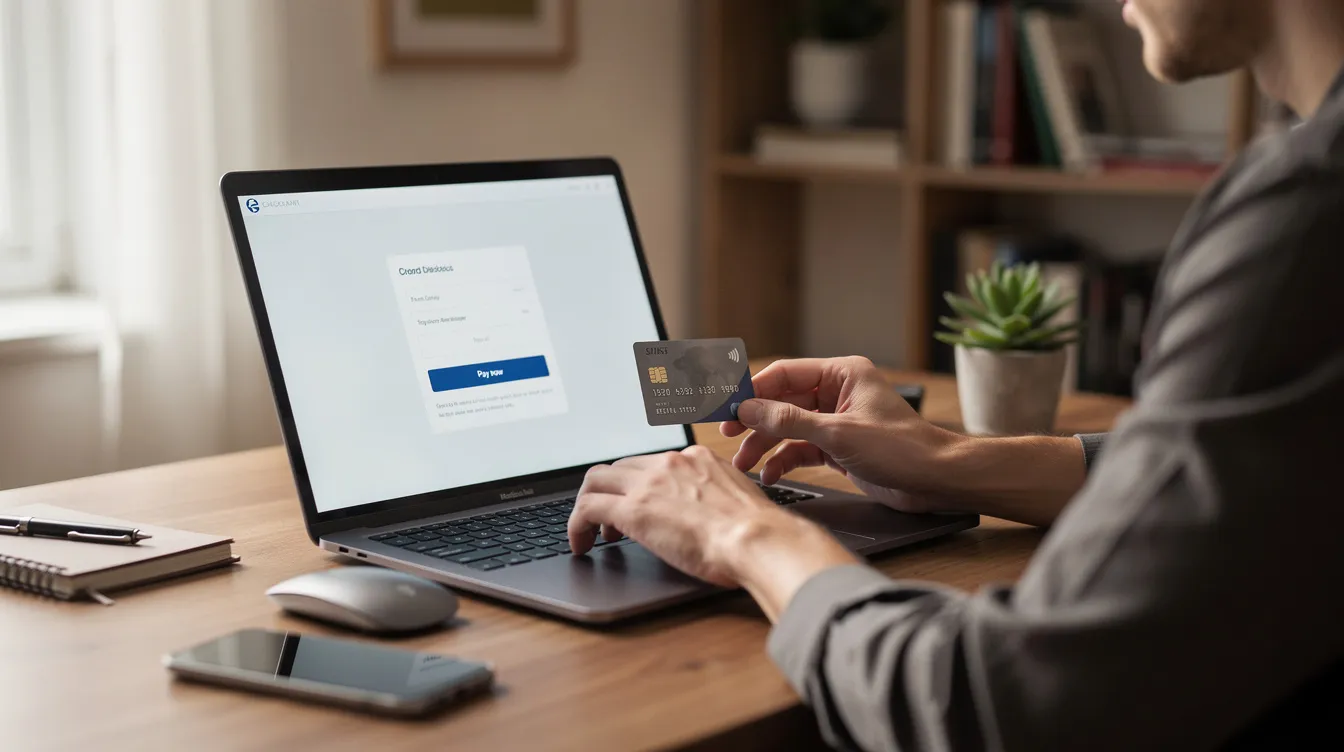
Here is the transaction process in plain terms:
-
The customer enters their payment details (card number, expiry, CVV) or selects a wallet such as Apple Pay or Google Pay on your checkout, invoice link, or virtual terminal.
-
The payment gateway encrypts that sensitive payment data immediately, so raw card data never sits exposed on your servers.
-
The payment gateway sends a secure authorisation request to the payment processor and acquiring bank, including fraud checks such as AVS, CVV verification, and any 3D Secure challenge required by Strong Customer Authentication rules.
-
The acquiring bank routes the request through the payment processing network to the card scheme (Visa, Mastercard), which contacts the issuing bank (the customer’s bank).
-
The issuing bank checks the customer’s bank account for available funds and responds. The authorisation response from the bank indicates whether a transaction is approved or declined.
-
That response flows back through the scheme, acquirer, and gateway. The payment gateway verifies the result and returns a success or failure message to the customer.
-
If approved, the transaction is cleared. Settlement follows: the acquirer holds funds briefly in your merchant account, deducts fees, then transfers the net amount to your business account.
Throughout transaction initiation and processing, the gateway facilitates payment authorisation and communicates transaction status back to your site. The customer only sees a brief spinner, then a confirmation page.
Our team maps this entire payment flow against your current costs, then uses that detail to negotiate better rates with banks and gateway providers on your behalf. Speak to us to start that analysis.
Merchant Account vs Business Bank Account vs Payment Gateway
Many UK business owners confuse these three components. That confusion often leads to accepting bundled deals without questioning the fees inside them.
|
Component |
What It Does |
Who Provides It |
|---|---|---|
|
Merchant account |
Specialist holding account where card receipts sit before settlement |
Acquiring bank |
|
Business bank account |
Day to day account for wages, suppliers, cash flow |
High street or business bank |
|
Payment gateway |
Technology layer that collects, encrypts, and routes customer data for authorisation |
Gateway provider or PSP |
A merchant account is not your everyday business account. It is controlled by the acquiring bank and exists solely to receive and hold customer payments from card transactions before those funds settle into your main bank account.
Your business bank account cannot authorise or route card payments on its own. It simply receives the settled funds.
The payment gateway is the secure technology layer that collects card or wallet payment information, encrypts it, and passes it to the acquirer for authorisation. It transmits payment data but does not hold money.
Some providers bundle all three into one package. While that adds simplicity, it can hide higher fees. We compare merchant account and gateway options across the UK market to ensure you are not paying “retail” pricing when wholesale rates are available.
Payment Gateway vs Payment Processor (And Other Common Comparisons)
We often untangle confusing terminology for clients before we even start negotiations. Getting the definitions right helps you understand where your money goes.
Payment Gateway vs Payment Processor
A payment gateway captures and encrypts card, wallet, or bank details at the point of sale, then routes transaction data as a secure authorisation request to the payment processor or acquirer. A payment gateway securely transmits payment information, while a payment processor authorises transactions and transfers funds between financial institutions.
Payment processors connect acquirers to card schemes for transactions, handling the routing, clearing, and settlement that actually moves money. The gateway is the secure front door; the processor is the back office engine.
Some UK providers combine both a payment gateway and a payment processor on one platform, which can be efficient but is not always the cheapest option. We compare card processing fees across separate and bundled solutions, then present you with a clear, like for like view of your options.
Merchant Account vs Payment Gateway
Think of the merchant account as a temporary parking space for card receipts, controlled by the acquiring bank rather than by the payment gateway provider. The gateway talks to the merchant account but does not hold the money. It passes instructions and status updates.
For example, a UK subscription business might use an ecommerce payment gateway for recurring payments that settles daily into its merchant account, then sweeps funds to its main bank account. Payment gateways should support automated recurring payments for subscription services, making this flow seamless.
We arrange merchant accounts for both standard and high risk sectors, then connect them to suitable gateways so you do not need to manage separate negotiations.
Payment Gateway vs Payment Aggregator
A payment aggregator uses one master merchant account for many small businesses. Each sub merchant does not hold its own merchant account. Examples include Square, SumUp, and PayPal.
A dedicated merchant account plus a separate gateway often delivers lower fees for established or higher volume UK merchants. Aggregators can be quicker to board but may freeze funds more readily and charge higher blended rates.
We advise on when to move from an aggregator to a full merchant account plus gateway structure, and we handle the full migration on your behalf. Let us review your current provider so we can identify whether you are using the right model for your business model and turnover.
Types Of Payment Gateways For UK Businesses
Choosing the right payment gateway is crucial for e-commerce success. The best type depends on your risk appetite, technical resources, and how much control you want over checkout. Payment gateways can be hosted, self-hosted, or integrated. Hybrid gateways combine features of hosted and self-hosted solutions. Self-hosted gateways require installation on the merchant’s servers, giving full control but adding PCI scope. You should also choose a payment gateway that offers multiple payment methods to maximise conversion.
Hosted Payment Gateway & Hosted Payment Page
A hosted payment gateway redirects the customer from your website or invoice link to a secure payment page hosted by the provider, then returns them after payment is complete. Hosted gateways redirect customers to a third-party payment page, keeping card data entirely off your servers.
This option significantly reduces your PCI DSS scope and suits SMEs and “hard to place” industries that want strong compliance with minimal technical overhead. Many providers let you add your logo, brand colours, and UK contact details to the hosted payment page so it still feels consistent with your site.
We configure hosted pages to support major payment methods such as Visa, Mastercard, Apple Pay, Google Pay, and alternative payment methods popular in the UK and EU. A white label payment gateway option is also available through certain providers, letting you present the secure payment page entirely under your own brand.
Integrated / API Ecommerce Payment Gateway
Integrated gateways allow customers to pay directly on the merchant’s site. An integrated gateway keeps the entire checkout on your domain, with payment fields loaded via secure scripts or APIs.
This approach gives maximum control over UX, localisation, and loyalty features. Payment gateways enhance customer experience with seamless transactions, and they can reduce cart abandonment with seamless checkout flows that keep customers on your page.
The trade off is more development work and careful PCI planning. Whether you run Shopify, WooCommerce, Magento, or a custom headless build, we can broker gateway connections optimised for your platform. We help your developers choose the right integration route, from client side encryption to server to server integration, then secure competitive pricing with partner acquirers.
Virtual Terminal, Pay By Link, And Remote Payments
A virtual terminal is a secure web based form where staff can key in card details for mail order or telephone order (MOTO) sales. This suits legal practices, clinics, B2B suppliers, and any business taking secure payment over the phone.
Pay by link sends customers a secure URL via email, SMS, or invoice. They complete payment on a hosted payment page without needing to visit an online store. A UK accountancy firm taking fees over the phone, or a trades company texting a link after a call out, can both avoid manual bank transfers and speed up cash flow through digital payments.
We ensure these tools are correctly configured with 3D Secure where appropriate and priced fairly, not at inflated rates often charged to small merchants. These channels support digital wallet payments and debit cards alongside standard credit card acceptance, broadening your payment acceptance options.
Security, PCI DSS, And Fraud Protection
Any business handling card payments in 2026 must treat security and compliance as core infrastructure, not an afterthought. Payment gateways encrypt sensitive data to prevent fraud, and they must comply with PCI DSS security standards. The UK and EU regulatory environment adds further requirements around Strong Customer Authentication.
PCI DSS Compliance And Regulatory Requirements
PCI DSS is the card industry’s global security standard. Every UK business accepting card payments must follow it, even if they rely on a hosted gateway. PCI DSS compliance means implementing controls around how you handle, store, and transmit card data.
A secure payment gateway reduces the merchant’s PCI scope by handling encryption, storage, and transmission of sensitive data. Payment gateways use SSL encryption to protect cardholder information, and they must be PCI DSS compliant for security. However, using a gateway does not remove the need for basic controls and annual validation on your side. Payment gateways must conduct regular audits to maintain PCI compliance.
Under the UK’s Payment Services Regulations 2017 (retaining PSD2 requirements), Strong Customer Authentication is mandatory for most online payments. Payment gateways implement 3D Secure for additional transaction verification, ensuring you meet SCA obligations without storing sensitive card data on your own servers.
We liaise with acquiring banks, gateways, and your internal team to ensure your setup meets compliance expectations without unnecessary complexity or cost.
Fraud Prevention And Chargeback Reduction
Modern gateways provide a layered fraud detection toolkit:
-
Tokenisation replaces sensitive card data with unique symbols, so you can handle recurring billing without storing raw card numbers.
-
Rule based screening and velocity limits block rapid fire attempts from the same card or device.
-
AI driven risk scoring and anomaly detection flag unusual patterns before authorisation.
-
AVS (Address Verification) and CVV checks confirm the cardholder’s identity.
-
Device fingerprinting identifies suspicious hardware or browser configurations.
Payment gateways encrypt data to prevent payment fraud and can reduce chargebacks by blocking suspicious transactions before they complete. These tools protect payment data and keep your chargeback ratio low, which matters because high ratios can trigger fines or account termination.
For high risk industries (travel, gaming, subscriptions, CBD), a strong fraud strategy improves underwriting outcomes and can reduce rolling reserves. High risk merchant account instant approval is rarely realistic, but a well prepared application with robust fraud controls dramatically improves your chances.
We help design gateway level fraud rules that balance security with approval rates, then use our relationships with acquirers to argue for lower reserves and better terms on your behalf.
Costs, Fees, And How We Use Volume Leverage
UK payment gateway pricing can be complex. Your total cost of ownership includes several components:
|
Fee Type |
Typical Range |
|---|---|
|
Transaction fees (percentage + fixed pence) |
0.4% to 2.5%+ depending on card type and channel |
|
Monthly fees (gateway, merchant account) |
£10 to £30 each |
|
Setup fees |
£0 to £200 (often waived) |
|
Cross border / foreign card surcharges |
0.5% to 1.5% additional |
|
Chargeback fees |
£15 to £25 per dispute |
UK interchange fee caps sit at roughly 0.2% for consumer debit cards and 0.3% for consumer credit cards on domestic transactions. Commercial and business cards are uncapped and often range from 1% to 2%.
Evaluate transaction fees to minimise costs for your business by understanding which pricing model suits you. Blended or flat rate pricing (common with aggregators) bundles everything into one percentage, which is simple but often expensive at volume. Interchange Plus or Interchange Plus Plus (IC++) pricing separates interchange, scheme fees, and acquirer margin, giving full transparency and room to negotiate.
Our role as a merchant services broker is to pool client volume so we can negotiate below standard rate pricing with acquiring banks and gateway providers. Banks give us better rates because we bring them volume consistently. Why pay retail rates when you can access our wholesale rates?
Transaction fees should be compared when selecting a payment gateway, and that is exactly what we do. Upload your recent merchant account and gateway statements so we can quantify potential savings in pounds and pence.
International Payments And Multi Currency Gateways
Many UK businesses now sell across Europe, North America, and beyond. The right ecommerce payment gateway must handle international payment processing efficiently.

Multi currency processing lets you price and accept payments in currencies like EUR, USD, and AUD while settling into GBP. Multi-Currency Conversion allows prices in over 100 currencies, and providers like Emerchantpay support payments in over 150 currencies. International payment gateways can handle currency conversions automatically at the point of checkout.
Payment gateways should facilitate international transactions and support multi-currency, and many can support over 60 global payment methods. They enable cross-border payments for global transactions and can integrate with local and global payment methods. Adding local payment methods such as SEPA, iDEAL, Sofort, and popular regional wallets through local bank integration can significantly increase conversion for international buyers. Support for international payment methods means customers pay how they prefer.
Typical pain points include unexpected FX mark ups, extra cross border scheme fees, and increased fraud risk on international transactions. We work with UK and EU acquiring banks to secure competitive cross border rates and ensure the gateway is configured correctly for your target markets. If you sell internationally, let us audit your cross border costs.
How We Help You Choose And Implement The Right Payment Gateway
Our team acts as an expert extension of your finance and operations function, not as a generic comparison site. A reliable payment gateway paired with the right merchant account transforms payment processing from a cost centre into a competitive advantage.
Here is our typical process:
-
Review your recent merchant account statements, gateway invoices, monthly volumes, average transaction values, card mix, and the countries you sell into.
-
Analyse where your current costs sit versus market benchmarks, breaking out interchange, scheme fees, acquirer margin, and gateway charges.
-
Shortlist acquiring bank and gateway combinations suited to your sector, risk profile, and technical platform.
-
Negotiate using our volume leverage to push for lower acquirer margins, reduced monthly fees, better settlement terms, and favourable contract durations.
-
Onboard by handling all application paperwork, technical setup (including SCA configuration, fraud rules, and PCI scope), testing, and staff training.
A payment gateway serves as the backbone of your digital transactions, and our job is to make sure that backbone is strong, compliant, and cost effective. Our service is free to you because we are paid by the acquiring bank or gateway provider once your account is live.
Speak to our team today or upload your most recent processing statement for a detailed side by side comparison. We do the hard work. You keep the savings.
FAQ: Payment Gateways And Our Brokerage Service
Below are the practical questions UK business owners ask us most often. The easiest way to get tailored answers is to contact us directly with a recent merchant statement.
How quickly can we help you go live with a new payment gateway?
Timelines vary by risk profile and acquiring bank, but many standard risk UK merchants can go live within 3 to 10 working days once documents are provided. High risk sectors may take longer because underwriters need more detail on chargeback history, business model, and compliance controls.
We speed up the process by packaging the application correctly first time and pre matching you with banks that already support your industry. Send us basic information about your turnover and sector and we can give you a realistic timeframe before any formal application.
Can we help if your business is in a high risk industry?
Yes. We regularly work with high risk merchant account applicants in areas such as online subscriptions, travel, nutraceuticals, and digital services. Our value is knowing which acquiring banks and gateways will even look at these sectors, and what risk controls they expect.
We negotiate on rolling reserves, settlement delays, and volume caps, aiming to keep these as light as the risk profile allows. Speak to us before you apply directly to a bank, as avoidable declines can make future approvals harder.
Do you only help with online payment gateways or also with card machines?
We handle the full merchant services stack: ecommerce payment gateways, virtual terminals, pay by link, and physical card terminals for in person sales. The cheapest card payment machine for your business depends on volume, connectivity, and whether you also need a gateway. We find the combination that costs least overall.
Many UK businesses benefit from having gateway and terminal processing under one acquiring relationship, but we also support mixed setups where it makes financial sense. Let us audit all of your payment channels together for maximum savings.
What information do we need to compare your current payment gateway costs?
We need recent merchant account statements (ideally three months), gateway invoices, monthly sales volumes, average transaction value, main card types accepted, and countries you sell into. We do not need access to customer card data, only commercial information about fees and volumes.
We use this to build a like for like cost model, then overlay alternative gateway and acquirer offers to show potential savings clearly. Upload at least three months of statements so we can account for seasonal peaks such as Black Friday or Christmas trading.
Is there any obligation if we complete a cost review with you?
There is no obligation to switch providers after our review, and our analysis is free. We only earn a commission from the acquiring bank or gateway provider if you decide to proceed with one of the options we negotiate.
This aligns our incentives with your goal of reducing fees and improving reliability. We rely on long term relationships, not one off sales. Send us your latest statement today so we can show you, in pounds and pence, what you could be saving.
Payment Gateway Services UK: Take Payments Without Overpaying
Want to accept payments online without losing a chunk of your revenue to inflated fees? We can help. As a specialist merchant services broker, we work across the UK payments landscape to find you the right payment gateway, the right acquiring bank, and the right deal. This guide explains how payment gateways work, what they cost, and how we use our buying power to cut those costs for you.
Key Takeaways
-
A payment gateway is the secure bridge that lets a UK business accept card and electronic payments online, in app, and remotely. It securely transmits payment information between all parties involved in a transaction.
-
We act as a merchant services broker in the UK, using our cumulative volume with acquiring banks and payment gateway providers UK wide to negotiate lower processing and gateway rates for our clients.
-
We help set up both a payment gateway and a merchant account so the full payment flow works smoothly, from customer checkout to your business bank account, including international payments.
-
Our service is completely free to you. The acquiring bank or payment gateway provider pays us once your account is live. We often beat standard processing rates by a significant margin.
-
Upload a recent statement to us today so we can compare card processing fees and show you exactly what your payment gateway cost could look like with our rates.
What Is A Payment Gateway (And Why UK Businesses Need One)?
A payment gateway is secure software that moves payment data between the customer, the merchant’s website or app, the merchant’s acquiring bank, and the card schemes (Visa, Mastercard). It is the technology that lets you accept online payments safely, and it is essential for any UK business selling goods or services remotely.
A gateway is not the same as a card machine. While a payment terminal handles face to face chip and PIN or contactless transactions for in store payments, a payment gateway handles ecommerce checkouts, pay by link invoices, virtual terminal entries, and in app purchases. Payment gateways act as intermediaries between customers and banks, enabling businesses to accept payments anytime and anywhere.
The gateway’s job is to encrypt and route transaction data. It does not move actual money. That role belongs to the acquiring bank and card schemes, which settle funds into your merchant account and then into your bank account. Payment gateways securely transmit payment information between all parties, and they support multiple payment methods including credit cards and digital wallets.
In practice, this looks like a UK online store taking card payments at checkout, a consultancy firm using a hosted payment page so clients can pay invoices online, or a tradesperson texting a pay by link after a call out instead of waiting on a slow bank transfer. Each of these businesses needs a gateway to process electronic payments.
We help UK business owners choose and configure the right payment gateway so they can easily accept payments without drowning in technical jargon or compliance rules. Let us handle the complexity while you focus on your customers.
How Online Payments Work With A Payment Gateway (Step By Step)
A typical card not present transaction completes in one to three seconds from the customer’s perspective. Behind the scenes, several parties and security checks work together to make that happen. Understanding how a payment gateway work helps you spot where costs hide.
Here is the transaction process in plain terms:
-
The customer enters their payment details (card number, expiry, CVV) or selects a wallet such as Apple Pay or Google Pay on your checkout, invoice link, or virtual terminal.
-
The payment gateway encrypts that sensitive payment data immediately, so raw card data never sits exposed on your servers.
-
The payment gateway sends a secure authorisation request to the payment processor and acquiring bank, including fraud checks such as AVS, CVV verification, and any 3D Secure challenge required by Strong Customer Authentication rules.
-
The acquiring bank routes the request through the payment processing network to the card scheme (Visa, Mastercard), which contacts the issuing bank (the customer’s bank).
-
The issuing bank checks the customer’s bank account for available funds and responds. The authorisation response from the bank indicates whether a transaction is approved or declined.
-
That response flows back through the scheme, acquirer, and gateway. The payment gateway verifies the result and returns a success or failure message to the customer.
-
If approved, the transaction is cleared. Settlement follows: the acquirer holds funds briefly in your merchant account, deducts fees, then transfers the net amount to your business account.
Throughout transaction initiation and processing, the gateway facilitates payment authorisation and communicates transaction status back to your site. The customer only sees a brief spinner, then a confirmation page.
Our team maps this entire payment flow against your current costs, then uses that detail to negotiate better rates with banks and gateway providers on your behalf. Speak to us to start that analysis.
Merchant Account vs Business Bank Account vs Payment Gateway
Many UK business owners confuse these three components. That confusion often leads to accepting bundled deals without questioning the fees inside them.
|
Component |
What It Does |
Who Provides It |
|---|---|---|
|
Merchant account |
Specialist holding account where card receipts sit before settlement |
Acquiring bank |
|
Business bank account |
Day to day account for wages, suppliers, cash flow |
High street or business bank |
|
Payment gateway |
Technology layer that collects, encrypts, and routes customer data for authorisation |
Gateway provider or PSP |
A merchant account is not your everyday business account. It is controlled by the acquiring bank and exists solely to receive and hold customer payments from card transactions before those funds settle into your main bank account.
Your business bank account cannot authorise or route card payments on its own. It simply receives the settled funds.
The payment gateway is the secure technology layer that collects card or wallet payment information, encrypts it, and passes it to the acquirer for authorisation. It transmits payment data but does not hold money.
Some providers bundle all three into one package. While that adds simplicity, it can hide higher fees. We compare merchant account and gateway options across the UK market to ensure you are not paying “retail” pricing when wholesale rates are available.
Payment Gateway vs Payment Processor (And Other Common Comparisons)
We often untangle confusing terminology for clients before we even start negotiations. Getting the definitions right helps you understand where your money goes.
Payment Gateway vs Payment Processor
A payment gateway captures and encrypts card, wallet, or bank details at the point of sale, then routes transaction data as a secure authorisation request to the payment processor or acquirer. A payment gateway securely transmits payment information, while a payment processor authorises transactions and transfers funds between financial institutions.
Payment processors connect acquirers to card schemes for transactions, handling the routing, clearing, and settlement that actually moves money. The gateway is the secure front door; the processor is the back office engine.
Some UK providers combine both a payment gateway and a payment processor on one platform, which can be efficient but is not always the cheapest option. We compare card processing fees across separate and bundled solutions, then present you with a clear, like for like view of your options.
Merchant Account vs Payment Gateway
Think of the merchant account as a temporary parking space for card receipts, controlled by the acquiring bank rather than by the payment gateway provider. The gateway talks to the merchant account but does not hold the money. It passes instructions and status updates.
For example, a UK subscription business might use an ecommerce payment gateway for recurring payments that settles daily into its merchant account, then sweeps funds to its main bank account. Payment gateways should support automated recurring payments for subscription services, making this flow seamless.
We arrange merchant accounts for both standard and high risk sectors, then connect them to suitable gateways so you do not need to manage separate negotiations.
Payment Gateway vs Payment Aggregator
A payment aggregator uses one master merchant account for many small businesses. Each sub merchant does not hold its own merchant account. Examples include Square, SumUp, and PayPal.
A dedicated merchant account plus a separate gateway often delivers lower fees for established or higher volume UK merchants. Aggregators can be quicker to board but may freeze funds more readily and charge higher blended rates.
We advise on when to move from an aggregator to a full merchant account plus gateway structure, and we handle the full migration on your behalf. Let us review your current provider so we can identify whether you are using the right model for your business model and turnover.
Types Of Payment Gateways For UK Businesses
Choosing the right payment gateway is crucial for e-commerce success. The best type depends on your risk appetite, technical resources, and how much control you want over checkout. Payment gateways can be hosted, self-hosted, or integrated. Hybrid gateways combine features of hosted and self-hosted solutions. Self-hosted gateways require installation on the merchant’s servers, giving full control but adding PCI scope. You should also choose a payment gateway that offers multiple payment methods to maximise conversion.
Hosted Payment Gateway & Hosted Payment Page
A hosted payment gateway redirects the customer from your website or invoice link to a secure payment page hosted by the provider, then returns them after payment is complete. Hosted gateways redirect customers to a third-party payment page, keeping card data entirely off your servers.
This option significantly reduces your PCI DSS scope and suits SMEs and “hard to place” industries that want strong compliance with minimal technical overhead. Many providers let you add your logo, brand colours, and UK contact details to the hosted payment page so it still feels consistent with your site.
We configure hosted pages to support major payment methods such as Visa, Mastercard, Apple Pay, Google Pay, and alternative payment methods popular in the UK and EU. A white label payment gateway option is also available through certain providers, letting you present the secure payment page entirely under your own brand.
Integrated / API Ecommerce Payment Gateway
Integrated gateways allow customers to pay directly on the merchant’s site. An integrated gateway keeps the entire checkout on your domain, with payment fields loaded via secure scripts or APIs.
This approach gives maximum control over UX, localisation, and loyalty features. Payment gateways enhance customer experience with seamless transactions, and they can reduce cart abandonment with seamless checkout flows that keep customers on your page.
The trade off is more development work and careful PCI planning. Whether you run Shopify, WooCommerce, Magento, or a custom headless build, we can broker gateway connections optimised for your platform. We help your developers choose the right integration route, from client side encryption to server to server integration, then secure competitive pricing with partner acquirers.
Virtual Terminal, Pay By Link, And Remote Payments
A virtual terminal is a secure web based form where staff can key in card details for mail order or telephone order (MOTO) sales. This suits legal practices, clinics, B2B suppliers, and any business taking secure payment over the phone.
Pay by link sends customers a secure URL via email, SMS, or invoice. They complete payment on a hosted payment page without needing to visit an online store. A UK accountancy firm taking fees over the phone, or a trades company texting a link after a call out, can both avoid manual bank transfers and speed up cash flow through digital payments.
We ensure these tools are correctly configured with 3D Secure where appropriate and priced fairly, not at inflated rates often charged to small merchants. These channels support digital wallet payments and debit cards alongside standard credit card acceptance, broadening your payment acceptance options.
Security, PCI DSS, And Fraud Protection
Any business handling card payments in 2026 must treat security and compliance as core infrastructure, not an afterthought. Payment gateways encrypt sensitive data to prevent fraud, and they must comply with PCI DSS security standards. The UK and EU regulatory environment adds further requirements around Strong Customer Authentication.
PCI DSS Compliance And Regulatory Requirements
PCI DSS is the card industry’s global security standard. Every UK business accepting card payments must follow it, even if they rely on a hosted gateway. PCI DSS compliance means implementing controls around how you handle, store, and transmit card data.
A secure payment gateway reduces the merchant’s PCI scope by handling encryption, storage, and transmission of sensitive data. Payment gateways use SSL encryption to protect cardholder information, and they must be PCI DSS compliant for security. However, using a gateway does not remove the need for basic controls and annual validation on your side. Payment gateways must conduct regular audits to maintain PCI compliance.
Under the UK’s Payment Services Regulations 2017 (retaining PSD2 requirements), Strong Customer Authentication is mandatory for most online payments. Payment gateways implement 3D Secure for additional transaction verification, ensuring you meet SCA obligations without storing sensitive card data on your own servers.
We liaise with acquiring banks, gateways, and your internal team to ensure your setup meets compliance expectations without unnecessary complexity or cost.
Fraud Prevention And Chargeback Reduction
Modern gateways provide a layered fraud detection toolkit:
-
Tokenisation replaces sensitive card data with unique symbols, so you can handle recurring billing without storing raw card numbers.
-
Rule based screening and velocity limits block rapid fire attempts from the same card or device.
-
AI driven risk scoring and anomaly detection flag unusual patterns before authorisation.
-
AVS (Address Verification) and CVV checks confirm the cardholder’s identity.
-
Device fingerprinting identifies suspicious hardware or browser configurations.
Payment gateways encrypt data to prevent payment fraud and can reduce chargebacks by blocking suspicious transactions before they complete. These tools protect payment data and keep your chargeback ratio low, which matters because high ratios can trigger fines or account termination.
For high risk industries (travel, gaming, subscriptions, CBD), a strong fraud strategy improves underwriting outcomes and can reduce rolling reserves. High risk merchant account instant approval is rarely realistic, but a well prepared application with robust fraud controls dramatically improves your chances.
We help design gateway level fraud rules that balance security with approval rates, then use our relationships with acquirers to argue for lower reserves and better terms on your behalf.
Costs, Fees, And How We Use Volume Leverage
UK payment gateway pricing can be complex. Your total cost of ownership includes several components:
|
Fee Type |
Typical Range |
|---|---|
|
Transaction fees (percentage + fixed pence) |
0.4% to 2.5%+ depending on card type and channel |
|
Monthly fees (gateway, merchant account) |
£10 to £30 each |
|
Setup fees |
£0 to £200 (often waived) |
|
Cross border / foreign card surcharges |
0.5% to 1.5% additional |
|
Chargeback fees |
£15 to £25 per dispute |
UK interchange fee caps sit at roughly 0.2% for consumer debit cards and 0.3% for consumer credit cards on domestic transactions. Commercial and business cards are uncapped and often range from 1% to 2%.
Evaluate transaction fees to minimise costs for your business by understanding which pricing model suits you. Blended or flat rate pricing (common with aggregators) bundles everything into one percentage, which is simple but often expensive at volume. Interchange Plus or Interchange Plus Plus (IC++) pricing separates interchange, scheme fees, and acquirer margin, giving full transparency and room to negotiate.
Our role as a merchant services broker is to pool client volume so we can negotiate below standard rate pricing with acquiring banks and gateway providers. Banks give us better rates because we bring them volume consistently. Why pay retail rates when you can access our wholesale rates?
Transaction fees should be compared when selecting a payment gateway, and that is exactly what we do. Upload your recent merchant account and gateway statements so we can quantify potential savings in pounds and pence.
International Payments And Multi Currency Gateways
Many UK businesses now sell across Europe, North America, and beyond. The right ecommerce payment gateway must handle international payment processing efficiently.
Multi currency processing lets you price and accept payments in currencies like EUR, USD, and AUD while settling into GBP. Multi-Currency Conversion allows prices in over 100 currencies, and providers like Emerchantpay support payments in over 150 currencies. International payment gateways can handle currency conversions automatically at the point of checkout.
Payment gateways should facilitate international transactions and support multi-currency, and many can support over 60 global payment methods. They enable cross-border payments for global transactions and can integrate with local and global payment methods. Adding local payment methods such as SEPA, iDEAL, Sofort, and popular regional wallets through local bank integration can significantly increase conversion for international buyers. Support for international payment methods means customers pay how they prefer.
Typical pain points include unexpected FX mark ups, extra cross border scheme fees, and increased fraud risk on international transactions. We work with UK and EU acquiring banks to secure competitive cross border rates and ensure the gateway is configured correctly for your target markets. If you sell internationally, let us audit your cross border costs.
How We Help You Choose And Implement The Right Payment Gateway
Our team acts as an expert extension of your finance and operations function, not as a generic comparison site. A reliable payment gateway paired with the right merchant account transforms payment processing from a cost centre into a competitive advantage.
Here is our typical process:
-
Review your recent merchant account statements, gateway invoices, monthly volumes, average transaction values, card mix, and the countries you sell into.
-
Analyse where your current costs sit versus market benchmarks, breaking out interchange, scheme fees, acquirer margin, and gateway charges.
-
Shortlist acquiring bank and gateway combinations suited to your sector, risk profile, and technical platform.
-
Negotiate using our volume leverage to push for lower acquirer margins, reduced monthly fees, better settlement terms, and favourable contract durations.
-
Onboard by handling all application paperwork, technical setup (including SCA configuration, fraud rules, and PCI scope), testing, and staff training.
A payment gateway serves as the backbone of your digital transactions, and our job is to make sure that backbone is strong, compliant, and cost effective. Our service is free to you because we are paid by the acquiring bank or gateway provider once your account is live.
Speak to our team today or upload your most recent processing statement for a detailed side by side comparison. We do the hard work. You keep the savings.
FAQ: Payment Gateways And Our Brokerage Service
Below are the practical questions UK business owners ask us most often. The easiest way to get tailored answers is to contact us directly with a recent merchant statement.
How quickly can we help you go live with a new payment gateway?
Timelines vary by risk profile and acquiring bank, but many standard risk UK merchants can go live within 3 to 10 working days once documents are provided. High risk sectors may take longer because underwriters need more detail on chargeback history, business model, and compliance controls.
We speed up the process by packaging the application correctly first time and pre matching you with banks that already support your industry. Send us basic information about your turnover and sector and we can give you a realistic timeframe before any formal application.
Can we help if your business is in a high risk industry?
Yes. We regularly work with high risk merchant account applicants in areas such as online subscriptions, travel, nutraceuticals, and digital services. Our value is knowing which acquiring banks and gateways will even look at these sectors, and what risk controls they expect.
We negotiate on rolling reserves, settlement delays, and volume caps, aiming to keep these as light as the risk profile allows. Speak to us before you apply directly to a bank, as avoidable declines can make future approvals harder.
Do you only help with online payment gateways or also with card machines?
We handle the full merchant services stack: ecommerce payment gateways, virtual terminals, pay by link, and physical card terminals for in person sales. The cheapest card payment machine for your business depends on volume, connectivity, and whether you also need a gateway. We find the combination that costs least overall.
Many UK businesses benefit from having gateway and terminal processing under one acquiring relationship, but we also support mixed setups where it makes financial sense. Let us audit all of your payment channels together for maximum savings.
What information do we need to compare your current payment gateway costs?
We need recent merchant account statements (ideally three months), gateway invoices, monthly sales volumes, average transaction value, main card types accepted, and countries you sell into. We do not need access to customer card data, only commercial information about fees and volumes.
We use this to build a like for like cost model, then overlay alternative gateway and acquirer offers to show potential savings clearly. Upload at least three months of statements so we can account for seasonal peaks such as Black Friday or Christmas trading.
Is there any obligation if we complete a cost review with you?
There is no obligation to switch providers after our review, and our analysis is free. We only earn a commission from the acquiring bank or gateway provider if you decide to proceed with one of the options we negotiate.